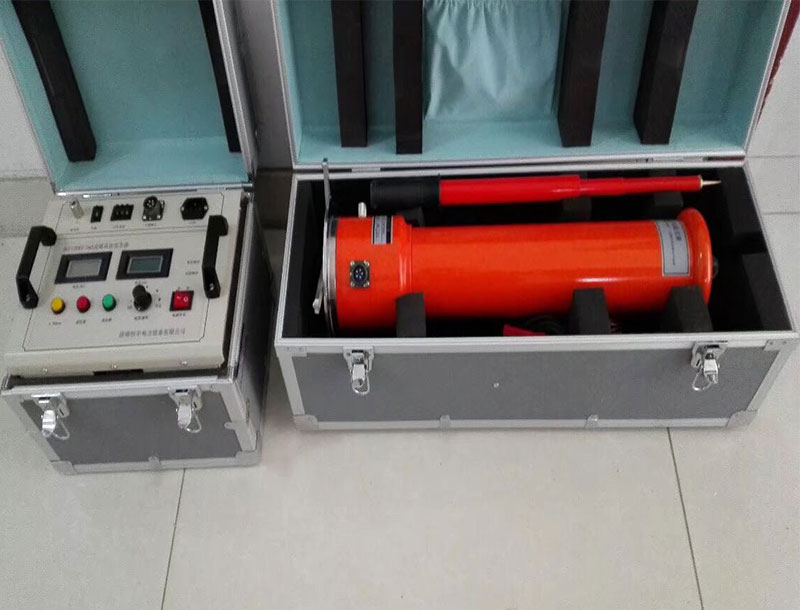
ZST-121 Solid Insulating Material Volume Resistivity and Surface Resistance Tester
ZST-121 Solid Insulating Material Volume Resistivity and Surface Resistance Tester fully complies with the national standard GB1410-2006 Test Methods for Insulation Resistance, Volume Resistivity and Surface Resistivity of Solid Electrical Insulating Materials, and ASTM D257 Test Methods for DC Resistance or Conductance of Insulating Materials. This instrument, equipped with different measuring electrodes (fixtures), can measure the volume resistivity and surface resistivity or conductivity of different materials (solid, powder, or liquid). It is suitable for measuring the volume and surface resistance values of various insulating materials in the form of rubber, plastics, films, powders, liquids, solids, and pastes. In addition to measuring resistance, this instrument can also directly measure weak currents.
II. Technical Specifications
No. | Item | Parameter |
1 | Resistance measurement range | 1×10⁴Ω ~1×10¹⁸Ω |
2 | Current measurement range | 2×10⁻⁴A~1×10-16A |
3 | Display mode | Digital LCD display |
4 | Built-in test voltage | 10V , 50V, 100V, 250V, 500V, 1000V |
5 | Basic accuracy | 1% |
6 | Operating environment | Temperature: 0℃~40℃, relative humidity <80% |
7 | Power supply | AC 220V, 50HZ, power consumption approx. 5W |
8 | Instrument dimensions | 285mm× 245mm× 120 mm |
9 | Weight | Approx. 5KG |
10 | Compact size, light weight, high accuracy | Dual display of resistance and current, stable performance, easy reading |
11 | Measuring ultra-high resistance is as simple as measuring ordinary resistance with a multimeter | Eliminates the inconvenience of multiplying coefficients at different test voltages or ranges as required by old-style high resistance meters |
III. Working Principle
According to Ohm's law, the measured resistance Rx equals the applied voltage V divided by the current I passing through. The traditional high resistance meter works by fixing the measurement voltage V and obtaining the resistance value by measuring the current I flowing through the sampling resistor. From Ohm's law, it can be seen that since the current I is inversely proportional to the resistance, not directly proportional, the displayed resistance value is nonlinear. That is, when the resistance is infinite, the current is zero, so the zero position of the meter is at ∞, and the scale near it is very dense, with low resolution. The entire scale is nonlinear. Moreover, when measuring different resistances, the voltage V also changes somewhat, so ordinary high resistance meters have poor accuracy and low resolution.
This resistivity tester simultaneously measures the voltage V across the resistance and the current I flowing through it, and uses a large-scale integrated circuit to perform the calculation of voltage divided by current. The result is then converted through A/D conversion and displayed digitally as the resistance value. Even if the voltage V across the resistance and the current I flowing through it change simultaneously, the displayed resistance value does not vary like that of ordinary high resistance meters due to changes in the measured voltage V or current I. Therefore, even if the measurement voltage, the measured resistance, or the power supply voltage changes, the impact on the result is minimal, and its measurement accuracy is very high (patented). Theoretically, the error can be zero, and in practice, the error can be as low as a few thousandths or ten-thousandths.
IV. Typical Applications
1. Measuring insulation material resistance (resistivity)
2. Measuring the resistance and resistivity of antistatic materials
3. Measuring the system resistance of raised floors used in computer rooms
4. Measuring the resistance of antistatic shoes and conductive shoes
5. Dark current measurement of photodiodes
6. Physics, optics, and materials research