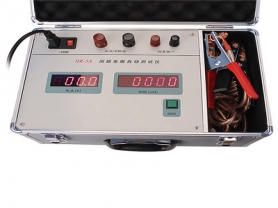
partial discharge phenomena at three different test points. This instrument plays an important role in the maintenance and fault diagnosis of power systems. Below is a typical title example of a three-channel partial discharge tester:
Three-Channel Partial Discharge Tester
Product Overview
Name: Three-Channel Partial Discharge Tester
Model: [Specific Model]
Manufacturer: [Manufacturer Name]
Main Features
Three-Channel Monitoring: Capable of simultaneously monitoring three different test points, improving detection efficiency.
Digital Signal Processing: Utilizes advanced digital signal processing technology to enhance detection accuracy and reliability.
High Sensitivity: Able to capture weak partial discharge signals.
Wide Frequency Band: Covers a broad ultrasonic frequency range, typically from 20kHz to 200kHz.
Portable Design: Lightweight and easy to carry, suitable for field operations.
Multifunctional Display: Equipped with a high-definition color LCD screen to display detection results and setting parameters.
Built-in Storage: Can save a large amount of detection data for subsequent analysis.
Long Battery Life: Supports long-duration continuous operation.
Quick Location: Helps locate discharge sources through audible indications and numerical displays.
Technical Parameters
Detection Frequency: 20kHz to 200kHz
Sensitivity: ≥100dB
Dynamic Range: ≥60dB
Battery Life: ≥8 hours
Display: High-definition color LCD, resolution [Specific Resolution]
Dimensions and Weight: [Specific Length]×[Specific Width]×[Specific Thickness], weight [Specific Weight]kg
Operating Temperature: -20℃ to +50℃
Storage Temperature: -40℃ to +70℃
Application Scenarios
Power Transformers: Detect partial discharge phenomena inside transformers.
Switchgear: Including high-voltage switchgear and ring main units.
Cable Joints: Inspect the insulation condition of cable joints and terminations.
GIS/GCB: Detect partial discharges in gas-insulated switchgear.
Motors: Assess the insulation status of motors.
Usage Instructions
Power On: Press the power button to start the device.
Settings: Adjust parameters such as detection frequency and sensitivity.
Detection: Place the probe near the equipment under test and observe the screen display.
Location: Locate the discharge source based on audible alerts and numerical display.
Data Recording: Save detection data.
Power Off: After detection, press and hold the power button to turn off the device.
Maintenance
Cleaning: Wipe the device surface with a soft cloth.
Storage: Store in a dry and ventilated place.
Calibration: Regularly calibrate the device.
Safety Precautions
Read Before Operation: Please read the user manual carefully.
Protective Measures: Wear necessary personal protective equipment.
No Touching: Do not touch high-voltage equipment.
Advantages and Features
Three-Channel Monitoring: Capable of simultaneously monitoring three different test points, improving detection efficiency.
Digital Signal Processing: Utilizes advanced digital signal processing technology to enhance detection accuracy and reliability.
High Sensitivity: Able to capture weak partial discharge signals.
Wide Frequency Band: Covers a broad ultrasonic frequency range, typically from 20kHz to 200kHz.
Conclusion
The three-channel partial discharge tester is an important tool in power system maintenance. It helps technical personnel detect potential partial discharge issues early, enabling preventive measures to ensure the safe and stable operation of the power system.
The above is a typical title example of a three-channel partial discharge tester. Specific product features and parameters may vary depending on the manufacturer and model. If you need detailed information about a specific model, please provide the specific model name or other relevant information.