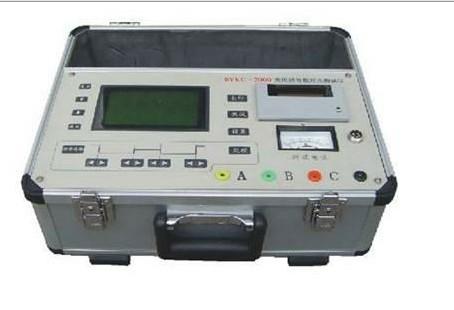
The WHX-300B high-voltage wireless phase verifier is a professional device used in power systems, primarily for phase verification and phase sequence verification of high-voltage power lines or substations. Below is an overview of an article about the WHX-300B high-voltage wireless phase verifier
WHX-300B High-Voltage Wireless Phase Verifier: An Efficient Tool for Phase Detection in Power Systems
Abstract
This article introduces the main functions, technical parameters, working principles, usage methods, and the significant role of the WHX-300B high-voltage wireless phase verifier in power system maintenance.
Introduction
In the operation and maintenance of power systems, phase measurement is an important and frequently performed task. Traditional phase measurement methods, such as using voltage transformers or high-voltage electroscopes, have issues like bulky equipment or reliance on weak indicator lights, making phase measurement both inconvenient and inaccurate. The introduction of the WHX-300B high-voltage wireless phase verifier has solved these problems, improving work efficiency and safety.
Main Functions
High-voltage wireless phase verification: Accurately measures the phase of high-voltage power lines or substations.
Frequency measurement: Can measure the frequency of the power system.
Phase sequence detection: Can identify the phase sequence (positive or negative) in the power system.
Voltage detection function: Used to verify whether a power line is energized.
Phase comparison: Compares the phase difference between two points wirelessly.
Technical Parameters
Voltage range: Suitable for voltage levels from 70V to 550kV, covering various applications from low voltage to ultra-high voltage.
Wireless transmission distance: Up to 30 meters, ensuring normal operation in complex environments.
Display: 3.5-inch LCD color screen, can display phase, frequency, voltage, and other phase verification results on the same screen, with dynamic vector diagrams.
Power supply: The host uses a rechargeable power source, while the X and Y collectors are powered by 5 AG13 batteries.
Auto power-off: The host automatically powers off about 8 minutes after startup to save energy.
Alarm function: When in contact with a strong electric field under test, the device automatically alarms, enhancing operational safety.
Working Principle
The working principle of the WHX-300B high-voltage wireless phase verifier is based on electromagnetic induction. It typically includes a transmitting unit (i.e., the collector) and a receiving unit (i.e., the host). The transmitting unit is responsible for collecting signals from the object under test and transmitting them wirelessly to the receiving unit. The receiving unit calculates the phase difference through its built-in processor and displays the result. Additionally, the device has strong anti-interference capability, allowing it to work normally in various electromagnetic interference environments.
Usage Method
Startup preparation: Turn on the device and select the appropriate voltage range.
Install the transmitter: Install the transmitter on the high-voltage line to be tested.
Receive signals: Use the receiver to receive signals and read phase data.
Read results: Observe the values on the display and pay attention to voice prompts.
Record data: Record the measurement results for subsequent analysis.
Safety Precautions
Pre-operation confirmation: Ensure that operators understand all safety regulations.
Equipment inspection: Check that the equipment is intact before each use.
Environmental factors: Pay attention to the operating environment and avoid using in extreme weather conditions.
Maintain distance: Ensure a sufficient safety distance from high-voltage live parts during operation.
Application Scenarios
Newly built, renovated, or expanded substations: Used for three-phase circuit phase verification tests to ensure that the phase sequence of transmission lines matches the phase sequence required by user three-phase loads.
Power lines: Used for phase verification before new lines are put into operation.
Cable joints: Used for phase confirmation before and after cable joints to ensure correct connection.
Grid connection operations: Used for phase calibration before generator grid connection.
Conclusion
The WHX-300B high-voltage wireless phase verifier, with its advanced technology and convenient operation, has become an important tool for phase measurement in power systems. It not only improves work efficiency but also greatly enhances operational safety.
Please note that this article provides an overview. For specific use, please refer to the user manual of the specific model or consult the manufacturer for detailed guidance and operating instructions.