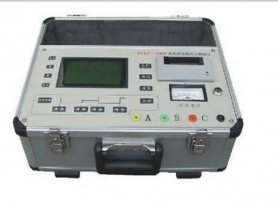
Such instruments are of great significance in fields such as power system maintenance, electronic manufacturing, and scientific research development. They help engineers and technicians accurately evaluate component parameters, ensuring that circuit performance meets design requirements. The following is detailed information about capacitance and inductance testers.
Main Functions of Capacitance and Inductance Testers
Capacitance Measurement: It can precisely measure the capacitance of various types of capacitors, including fixed and variable capacitors, and is widely used in filters, oscillator circuits, and more.
Inductance Measurement: Used to determine the inductance value of coils or transformers, suitable for applications such as RF circuits and power converters.
Dissipation Factor (D) Measurement: Evaluates the quality of capacitors or inductors by measuring their energy loss, which is one of the important indicators for assessing the quality factor of components.
Resistance Measurement: Some advanced models also support measuring resistance in series or parallel with capacitors or inductors, helping to fully understand component characteristics.
Features and Technical Specifications
High-Precision Measurement: Utilizes advanced measurement technology to provide high resolution and accuracy, meeting precision measurement needs.
Wide Measurement Range: Supports a broad measurement range from picofarads (pF) to farads (F) and from nanohenries (nH) to henries (H), accommodating various applications.
Automated Operation: Many modern devices are equipped with auto-ranging, auto-calibration, and other features, simplifying the operation process.
User-Friendly Interface: Typically equipped with a clear display and intuitive operation panel, making it easy for users to get started quickly.
Portability: Some models are compact and lightweight, making them easy to carry for field use.
Application Areas
Power System Maintenance: Used to inspect the condition of capacitor banks and reactors in the power grid, preventing faults.
Electronic Product Manufacturing: Quality inspection of components on production lines to ensure product quality.
Scientific Research and Education: Provides reliable experimental data support for university laboratories and research institutions.
Repair Services: As a maintenance tool, it helps technicians locate and solve problems.
Usage Precautions
When using a capacitance and inductance tester, the following points should be noted:
Ensure that the component under test is fully discharged to avoid damaging the instrument or causing personal injury.
Select the appropriate measurement range based on the specific parameters of the component to avoid affecting measurement accuracy.
Regularly calibrate the instrument to ensure the accuracy of measurement results.
In summary, the capacitance and inductance tester is a very practical tool that not only improves work efficiency but also plays a key role in ensuring the normal operation of electrical systems. Correctly selecting and using such equipment can greatly enhance work quality and safety.