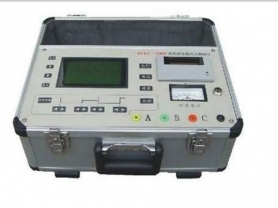
In the process of power systems, industrial equipment maintenance, and installation and commissioning of various electrical devices, loop resistance testing is an important step to ensure the quality of electrical connections and safe operation. As a professional instrument specifically used to measure the resistance between two points in a circuit, the loop resistance tester plays a vital role in detecting and preventing electrical faults. This article will detail the functional characteristics and application scenarios of the loop resistance tester.
1. Introduction
As the scale and complexity of electrical systems continue to increase, ensuring low resistance values at all electrical connection points has become crucial. High resistance or poor contact can lead to overheating, power loss, and even serious consequences such as fire. The loop resistance tester helps engineers and technicians identify potential problems by providing precise resistance measurement data, enabling them to take appropriate measures for repair or optimization.
2. Main Functions of the Loop Resistance Tester
High-precision measurement: Using advanced measurement technology, it can accurately measure small resistance values (typically in the micro-ohm range) to assess the quality of electrical connections.
Wide range adaptability: Suitable for loop resistance measurement in various electrical environments from low voltage to high voltage.
Fast response and stable readings: Equipped with fast sampling capability and stable reading display, it provides reliable measurement results even in harsh environments.
User-friendly interface design: Most models are equipped with an LCD display and intuitive operation buttons or touch screen, making it easy to operate and read data.
Portable design: Considering the needs of field operations, many loop resistance testers are designed to be compact and lightweight, easy to carry to different locations.
Multiple protection mechanisms: Including overvoltage protection, overcurrent protection, etc., ensuring the safety of users and equipment.
3. Application Scenarios
Power industry: Used for contact resistance measurement of high-voltage equipment such as transformers, circuit breakers, and disconnectors, ensuring the safety and reliability of electrical connections.
Manufacturing: In the production process, quality inspection of circuit connections for various electrical products to prevent product failures caused by poor contact.
Infrastructure construction: After installation of electrical systems in large projects such as railways and bridges, loop resistance testers are needed to check whether the wiring is qualified.
Maintenance and repair: Regularly conduct loop resistance tests on electrical facilities to promptly identify and solve potential problems, avoiding accidents.
4. Conclusion
The loop resistance tester is one of the indispensable tools in modern electrical engineering. It not only helps improve the safety of electrical systems but also effectively reduces energy waste caused by poor electrical connections. With technological advancements, future loop resistance testers will become more intelligent and multifunctional, providing users with more efficient and convenient services. Whether for professionals engaged in power engineering or ordinary electricians, mastering the correct use of this tool is of great significance for ensuring work quality and efficiency.