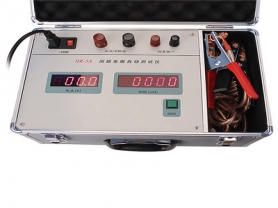
also known as high-voltage test transformer or AC/DC withstand voltage test device. It is an indispensable key equipment in preventive tests and handover tests of power equipment. Its main function is to generate high voltage to conduct AC withstand voltage tests or DC withstand voltage tests on power equipment (such as power transformers, circuit breakers, cables, arresters, insulators, etc.) to verify whether the insulation strength of these equipment meets the safe operation standards. The following are the core knowledge points about test transformers: 1. Main uses AC withstand voltage test: Simulate overvoltage conditions that may occur in power grid operation, and assess the ability of the equipment's main insulation to withstand power frequency overvoltage. This is the most effective and direct test method for identifying equipment insulation strength. DC withstand voltage test: Mainly used to check the insulation condition of capacitive equipment such as cables and capacitors, and to detect local defects that are not easily found in AC tests. Leakage current test: With a microammeter, measure the leakage current of equipment under high voltage. 2. Structural characteristics Compared with ordinary power transformers, test transformers have the following notable features: High voltage, small capacity: The output voltage is very high (from a few kV to hundreds of kV or even higher), but the output current is very small (usually from milliampere to ampere level), so the volume is relatively small. Large impedance: To limit short-circuit current, the short-circuit impedance is usually large. Extremely high insulation requirements: Due to operation under extremely high voltage, the internal insulation structure design is very strict, often using oil-immersed, dry-type (epoxy resin casting) or gas-insulated (SF6) structures. Short working time: Designed for intermittent operation, it cannot operate continuously at full load for a long time like power transformers. 3. Common types Oil-immersed test transformer: Traditional type, with good insulation performance and heat dissipation, suitable for large capacity and high voltage occasions, but it is heavy and has the risk of oil leakage. Dry-type test transformer: Made of epoxy resin casting, oil-free, pollution-free, small size, light weight, suitable for on-site mobile tests, but heat dissipation and single-unit voltage level are limited. Gas-insulated test transformer: Uses SF6 gas insulation, extremely small size, very light weight, suitable for ultra-high voltage and space-constrained occasions. Cascade test transformer: When extremely high test voltage (such as above 500kV) is required, multiple transformers are connected in series to reduce the manufacturing difficulty and transportation weight of a single unit. 4. Typical test wiring A complete withstand voltage test system usually includes: Voltage regulator: Adjusts the input voltage to achieve smooth voltage increase. Test transformer: Raises the low voltage to the high voltage required for the test. Protective resistor: Connected in series at the high-voltage output end to limit the short-circuit current during breakdown and protect the transformer. Voltage divider/high-voltage measuring device: Accurately measures the high voltage applied to the test object. Test object: The power equipment waiting to be tested. Control box/console: Integrates control, timing, alarm, and protection functions. 5. Safety precautions Since high voltage is involved, operation must strictly comply with safety regulations: Grounding: The test transformer shell, control console, and non-pressurized end of the test object must be reliably grounded. Fencing and warning: The test area should be fenced, with a "High Voltage Danger" warning sign, and dedicated personnel should supervise. Discharge: After the test, the test object and the high-voltage end of the transformer must be fully discharged with a discharge rod before disconnecting wires.