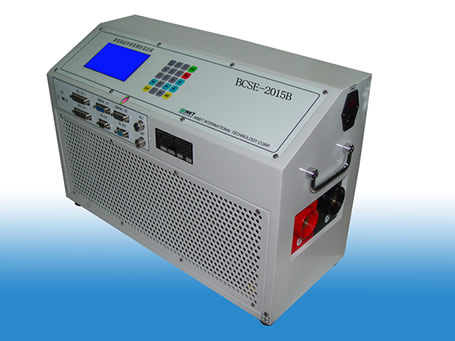
"Comprehensive characteristic tester" is not a standard name for a single product, but a general term for a functional category. In the fields of electric power, electronics, and industrial testing, it usually refers to an intelligent instrument that can integrate multiple testing functions on one device to comprehensively measure and analyze various electrical characteristics of specific objects (such as transformers, circuit breakers, transformers, batteries, etc.). Based on your previous questions (partial discharge, DC resistance, electrothermal electrical), you are most likely concerned with the "comprehensive characteristic tester" in the field of high-voltage power testing. The following are the most common types of "comprehensive characteristic testers" in this field and their detailed analysis: 1. Transformer Characteristic Comprehensive Tester (CT/PT Comprehensive Tester) This is the equipment most commonly referred to as a "comprehensive characteristic tester" in the power industry, mainly used for commissioning and preventive tests of current transformers (CT) and voltage transformers (PT). Core functions (multi-function in one machine): Volt-ampere characteristic test: automatically draws the excitation curve (U-I curve) and calculates the saturation point. Ratio test: measures the current/voltage ratio of CT/PT to determine if the number of turns is correct. Polarity test: automatically determines subtractive polarity/additive polarity. Ratio error/phase error test: measures accuracy class (such as 0.2S, 0.5 class) and evaluates metering errors. Secondary winding DC resistance: built-in DC resistance test module. Demagnetization function: automatically demagnetizes CT to eliminate the influence of residual magnetism. Load test: simulates secondary load to test load capacity. Transient characteristic analysis (high-end models): analyzes transient response for TPY class protection CTs. Application scenarios: acceptance of newly commissioned transformers in substations, regular preventive tests, fault troubleshooting. 2026 technical features: Fully automatic one-key test: no need to manually switch wiring or gears, the instrument automatically completes all items and generates reports. Wide range: supports testing from low-voltage distribution networks to 1000kV UHV transformers. Cloud diagnosis: test results are directly uploaded to the condition-based maintenance system, and AI automatically compares historical data to determine aging trends. 2. High-voltage Switch (Circuit Breaker) Characteristic Comprehensive Tester Used to measure the mechanical and electrical characteristics of high-voltage circuit breakers and disconnectors to ensure reliable opening and closing operations. Core functions: Time measurement: opening time, closing time, three-phase non-simultaneity, same-phase break non-simultaneity. Speed measurement: just-opening speed, just-closing speed, maximum speed, average speed (requires travel sensor). Travel measurement: total travel, overtravel, contact gap. Operating voltage test: tests the operating voltage range of opening/closing coils (low-voltage operation test). Current waveform analysis: records the current waveform of opening/closing coils, and judges mechanical/electrical faults such as core jamming and inter-turn short circuits in coils through waveform characteristics. Bounce analysis: detects the number and time of bounces when contacts close. Application scenarios: acceptance after major overhaul of circuit breakers, annual preventive tests, post-fault diagnosis. 2026 technical features: Multi-dimensional sensor fusion: integrates high-precision linear displacement sensors (resistive or magnetostrictive) and acceleration sensors. Waveform intelligent diagnosis: built-in expert library, automatically analyzes coil current waveforms and directly gives fault conclusions such as "core stuck" and "buffer failure". Wireless synchronization: multiple channels use wireless synchronization to simplify on-site wiring.