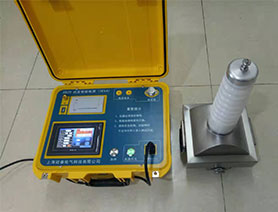
DC high current generator to maintain the rated test current
1. According to the debugging requirements, connect the current booster and the test object, and connect the power supply.
2. Select the position of the current transfer switch according to the current required by the test object. Since the current transformer does not allow open circuit, the current transfer switch can only be set to the "high" or "low" position, and cannot be placed in the middle position.
For equipment with higher power, adjust the short-circuit plate position through series or parallel connection to complete the high current gear conversion.
3. Close the power supply, the green light is on (if the green light is not on, turn the voltage regulator knob counterclockwise to zero until the green light is on), press the start button, the green light goes off and the red light is on, rotate the voltage regulator handle clockwise to increase the current to the required value.
4. Turn the voltage regulator handle counterclockwise to zero, press the stop button, the red light goes off and the green light is on, the test is completed.
5. In low temperature and humid environments, run the equipment for a period of time before use.
Precautions
- Single equipment is heavy; when moving for testing: pay attention to personal safety. The test work must be carried out by at least two people, one operating and one supervising to ensure safety. Test personnel should maintain a corresponding safe distance from the test object. Test personnel should wear protective gear and set up a warning area.
- Use in low temperature, high altitude, high temperature, and high humidity environments; please read the product manual in detail; prevent equipment damage.
- The shell must be grounded. Do not ignore personal safety accidents due to low voltage. The instrument must have good grounding. During use, the current booster transformer and the operating console must be reliably grounded to ensure safety.
- The wire from the secondary side of the current booster to the test object should not be too long, and the cross-sectional area should be sufficient (current density can be considered at 6-8A/mm). The contact surface should be cleaned (can be polished with fine sandpaper), otherwise the joint will heat up, and the current may not reach the rated value.
- Before work, check that the power supply has sufficient capacity; otherwise, the power cord heating and voltage drop will affect normal operation.
- There should be no flammable materials at the work site. For temperature rise tests, sufficient fire extinguishing equipment should be prepared.
- For continuous (temperature rise) tests, someone should be on duty at the site. Regularly check the heating condition of the current source equipment, wires, and joints, and make records. Due to grid voltage fluctuations, pay attention to adjusting the TD to maintain the rated test current. During the test, once any abnormal condition is found, immediately cut off the air switch power supply, find out the cause, and then conduct the test again. After the test, the voltage regulator must be returned to zero, cut off the power supply with the air switch, cut off the working power, and remove the test wiring in the reverse direction to ensure safety.
- The test work should comply with the relevant regulations of the electric power safety work regulations and formulate practical safety measures.
- If the LCD screen does not display and the printer does not work, it is forbidden to tap the panel, vibrate the machine, or disassemble it by yourself; contact the manufacturer for maintenance.
- If the equipment is placed for a long time, check and calibrate it with power on before use; after confirming it is correct, then use it.