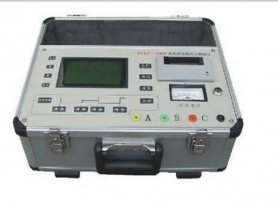
(i.e., the voltage transformation ratio) and the connection group. This type of instrument is widely used in power systems, industrial production, and scientific research experiments to ensure the correct connection and normal operation of transformers. Below is an article about the transformer ratio and connection group tester, covering its basic concepts, working principles, application scenarios, and usage precautions.
Overview of Transformer Ratio and Connection Group Tester
Definition and Function
A transformer ratio and connection group tester is a professional instrument used to detect the transformer winding ratio (i.e., the ratio of primary side voltage to secondary side voltage) and the connection group. By measuring the ratio and confirming the connection group, it ensures that the transformer is correctly connected during installation and operation, avoiding electrical faults caused by incorrect ratio or improper connection group. This type of instrument is widely used in transformer testing in power systems, industrial production, and scientific research experiments.
Importance
In power systems and industrial production, the correct connection and normal operation of transformers are crucial for the safety and reliability of the system. Regular testing with a transformer ratio and connection group tester can promptly detect errors in transformer connections, prevent equipment failures, and improve the operational efficiency and safety of the power system.
Working Principle
Measurement Methods
Transformer ratio and connection group testers typically use the following methods to measure the transformer ratio and confirm the connection group:
DC method: Apply a DC voltage to the transformer winding and measure the corresponding DC current to calculate the ratio.
AC method: Apply an AC voltage to the transformer winding and measure the corresponding AC current to calculate the ratio.
Phase comparison method: Compare the voltage phases of the primary and secondary sides of the transformer to confirm the connection group.
Components
A transformer ratio and connection group tester generally consists of the following parts:
Signal source: Provides the voltage or current signal required for measurement.
Measurement circuit: Used to collect voltage or current signals from the transformer winding.
Signal processing unit: Processes the collected signals, calculates the ratio, and confirms the connection group.
Display and control unit: Used to display measurement results and provide an operation interface for users to adjust test parameters.
Protection module: Provides overvoltage, overcurrent, and other protection functions to ensure safe operation of the equipment.
Connection interface: Used to connect to the transformer, such as high-voltage output interface.
Operation Process
Preparation stage: Select an appropriate transformer ratio and connection group tester according to test requirements, and prepare the transformer to be tested.
Connect equipment: Correctly connect the tester to the transformer to be tested, ensuring reliable connection.
Set parameters: Set relevant parameters of the tester according to test requirements, such as measurement method, test voltage, etc.
Execute test: Start the tester to measure the ratio and confirm the connection group.
Read results: Read the measurement results from the tester and record them.
Record data: Record test data, including ratio value, connection group, test date, time, environmental conditions, and other information.
Application Scenarios
Transformer ratio and connection group testers are widely used in multiple fields:
Power systems: Used to detect the ratio and connection group of transformers in power systems, ensuring correct transformer connection.
Industrial production: Used in industrial production to detect the ratio and connection group of motors, generators, high-voltage cables, and other equipment.
Scientific research experiments: Used in laboratories to study the electrical characteristics of transformers and other electrical equipment.
Equipment maintenance: Used during equipment maintenance and repair to assess the health of transformers and promptly detect potential connection errors.
Usage Precautions
Safety first: Ensure proper grounding of the equipment before testing, and operators should wear insulating protective gear.
Correct connection: Correctly connect the transformer to be tested according to the equipment manual to avoid equipment damage due to incorrect connection.
Gradual adjustment: When adjusting tester parameters, do so gradually to avoid sudden changes that may cause data distortion.
Regular calibration: Regularly calibrate the transformer ratio and connection group tester to ensure measurement accuracy.
Complete records: Record detailed data for each test, including ratio value, connection group, test date, time, environmental conditions, and other information for future reference.
Development Trends
With technological advancement, transformer ratio and connection group testers are also continuously developing:
Intelligence: Integrate advanced sensor technology and intelligent control systems to achieve remote monitoring and automated management.
Portability: More compact and lightweight design for easy carrying and on-site operation.
Multi-functionality: In addition to basic ratio measurement and connection group confirmation functions, other functions such as data recording and fault diagnosis are added.
High precision: Adopt more advanced measurement technology to improve measurement accuracy and reliability.
In summary, as an indispensable testing device in power systems, industrial production, and scientific research experiments, the transformer ratio and connection group tester plays an important role in ensuring the correct connection and normal operation of transformers. With continuous technological progress, future transformer ratio and connection group testers will become more intelligent, portable, and have higher measurement accuracy and functionality, better serving the application needs of various fields.