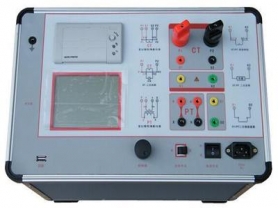

Capacitor bank inspection: Quickly screen hundreds or thousands of capacitors to identify individual units with abnormal capacitance (deviation exceeding ±5% or ±10%). Reactor fault diagnosis: When system harmonics are abnormal or reactors overheat, measure inductance to determine if inter-turn short circuits occur. Filter debugging: Measure the resonant point of filter branches to ensure they avoid characteristic harmonic frequencies. Acceptance testing: Verify that newly installed equipment parameters meet design requirements. 5. Operational precautions: Full discharge: Although the instrument has protection, it is essential to manually fully discharge capacitors using a dedicated discharge rod before testing - this is a critical step for safety! Wiring check: Ensure test leads are securely connected and the clamp CT direction is correct (usually marked with an arrow pointing to the ground grid). Environmental interference: Avoid testing during thunderstorms or near extremely strong electromagnetic interference sources; use shielded cables if necessary. Result analysis: Capacitance increase: Usually indicates internal element breakdown (plate short circuit), requiring immediate replacement. Capacitance decrease: Usually indicates internal element open circuit or dry dielectric. Excessive tanδ: Indicates insulation moisture or severe aging, increased losses, prone to thermal breakdown. 6. Selection recommendations: Routine maintenance: Choose single-phase portable instruments that support non-disconnect testing (clamp meter method) for maximum efficiency. Large substations/batch testing: Recommend three-phase automatic testers that can connect to three phases simultaneously, completing capacitance testing and balance rate calculation for three-phase capacitors in one go. High-precision laboratories: If measuring extremely low losses (tanδ < 0.0005) is required, choose laboratory-grade high-precision LCR bridges or dedicated dielectric loss testers. Due to the large number of reactive power compensation devices in the power grid and their high failure rate (such as capacitor bulging, breakdown, reactor inter-turn short circuits), this instrument is an essential tool in substation operation and maintenance, acceptance tests, and preventive tests. 1. Core test objects and functions: Parallel/series capacitors: Capacitance (C): Determine whether capacitor capacity increases due to internal element breakdown or decreases due to drying/open circuit. Dielectric loss tangent (tanδ): Reflects dielectric loss, judging insulation aging or moisture. Current at rated voltage: Estimate actual operating current. Series/filter reactors: Inductance (L): Determine if inter-turn short circuits (inductance decrease) or core loosening exist. Quality factor (Q value): Evaluate reactor efficiency. DC resistance: Some models integrate DC resistance testing.