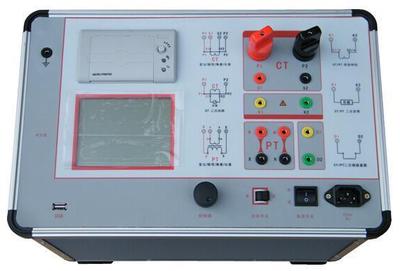
Compared to products from a few years ago, current capacitance and inductance testers have the following significant advantages: Extremely strong anti-interference capability: Using the heterodyne method (e.g., testing at 47.5Hz or 52.5Hz) and digital filtering technology, they can accurately measure in strong electromagnetic field environments (such as inside substations) without being affected by 50Hz power frequency interference. Wide range and high accuracy: Capacitance measurement range up to 0.001μF ~ 20,000μF. Inductance measurement range up to 0.1mH ~ 200H. Accuracy typically reaches ±0.2% or even ±0.1%. Integrated design: Combines capacitance, inductance, resistance, and loss testing in one unit, eliminating the need to change wiring or modules. Intelligent diagnostics: Built-in expert system that automatically judges equipment status based on measurement data (e.g., "capacitance decay exceeds standard", "risk of inter-turn short circuit in coils") and generates diagnostic reports. Wireless transmission and cloud management: Supports Bluetooth/Wi-Fi connection to mobile apps or upload to cloud management systems, enabling real-time data synchronization, historical trend analysis, and automatic report generation. Portability and battery life: Powered by large-capacity lithium batteries, with continuous working time up to 8-10 hours, and lightweight (typically <5kg), suitable for field operations. 4. Mainstream brands and selection references In the Chinese power market, common well-known brands include: Wuhan Moen (MOEORW): such as the MEJD-C series, known for strong anti-interference capability. Wuhan Huatian Electric Power (HV Hipot): such as the HTDL series, with high cost performance and easy operation. Shanghai Sute (SUTE): such as the ST series, widely used in East China. Baoding Tianwei/Xinnuo: higher market share in the northern region. International brands: such as OMICRON (CP TD1, MPD series, etc., although more focused on dissipation factor testers, they also have high-precision capacitance and inductance testing functions), expensive but extremely accurate, often used in laboratories or high-standard field applications. Selection suggestions: Confirm the test object: If mainly testing high-voltage shunt capacitors, a dedicated capacitance tester is sufficient; if you need to also test arc suppression coils and transformer windings, you must choose a combined capacitance and inductance tester. Pay attention to anti-interference indicators: Ask the manufacturer about testing stability in strong electric fields and whether heterodyne testing is supported. Output current/voltage capability: For large inductances (such as large arc suppression coils), the instrument needs to provide sufficient test current (e.g., 5A, 10A) to excite effective signals. Data management needs: Whether printing, USB export, or wireless upload functions are needed. 5. Operation precautions Discharge: Before testing capacitors, the test object must be fully discharged to ensure no residual charge, ensuring personnel and equipment safety. Correct wiring: When measuring capacitance, pay attention to distinguishing single-phase and three-phase wiring methods (e.g., delta, star). When measuring inductance, pay attention to the influence of DC resistance, and enable resistance compensation if necessary. Grounding: The instrument housing and the non-test terminal of the test object must be reliably grounded. Environmental factors: Avoid testing in thunderstorm or high humidity conditions; temperature affects capacitance values, so record the ambient temperature during testing for conversion to the 20°C standard value. Regular calibration: According to relevant metrology regulations, the instrument must be sent to a metrology institute or qualified organization for calibration annually. If you need parameter comparisons for specific models, detailed operating procedures, or fault case analysis, please feel free to tell me!