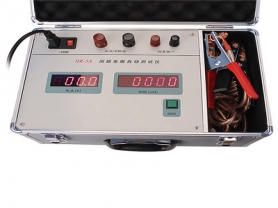
This device can help power engineers and technicians accurately understand the actual working capacity of transformers and their performance under different load conditions. Below is a detailed article about the transformer capacity characteristic tester.
Overview of Transformer Capacity Characteristic Tester
Transformer capacity characteristic tester is a professional device used for measuring and analyzing the capacity and electrical characteristics of power transformers. It can be used to evaluate the rated capacity, no-load loss, load loss, short-circuit impedance, and other important parameters of transformers, thereby ensuring that transformers operate safely and efficiently within their design parameters.
Main Functions
Capacity Measurement: Determines the maximum capacity of the transformer, i.e., the maximum power it can carry at rated voltage and frequency.
Loss Measurement: Includes no-load loss (iron loss) and load loss (copper loss), which are crucial for evaluating transformer efficiency.
Impedance Measurement: Measures the short-circuit impedance of the transformer, which is very important for protection system design and fault current calculation.
Temperature Rise Test: Monitors temperature changes during transformer operation, helping to evaluate its heat dissipation performance.
Waveform Analysis: Analyzes voltage and current waveforms during transformer operation to check for harmonics or other nonlinear phenomena.
Working Principle
Transformer capacity characteristic tester typically applies standard voltage and current signals to the primary or secondary side of the transformer and measures the corresponding output. By comparing input and output parameters, the transformer's capacity, losses, and other characteristic parameters can be calculated. Modern testers often adopt digital technology, enabling automatic data collection, result processing, and detailed report generation.
Application Scenarios
Factory Testing: Used during transformer manufacturing to verify that products meet design specifications.
On-site Acceptance: After transformer installation, on-site testing is conducted to ensure its performance meets grid requirements.
Regular Maintenance: Regular testing of transformers in operation to detect potential issues in a timely manner and perform maintenance.
Fault Diagnosis: When transformer abnormalities occur, it is used to quickly locate the cause of faults and help formulate effective repair plans.
Technical Features
High-precision Measurement: Utilizes advanced sensor technology and high-precision A/D converters to ensure accuracy of measurement results.
Multi-function Integration: One device can complete multiple test tasks, saving time and cost.
User-friendly: Equipped with an intuitive graphical user interface, making operation simpler.
Data Management: Supports data storage and transmission, facilitating later analysis and archiving.
Usage Steps
Preparation Phase: Ensure the transformer has been de-energized according to safety regulations and necessary safety protection measures are taken.
Connect the Tester: Correctly connect the tester to the transformer according to the tester's operation manual.
Set Parameters: Set corresponding test parameters such as voltage and current levels according to test requirements.
Execute Test: Start the tester, perform the test according to the predetermined procedure, and record data.
Analyze Results: Evaluate transformer performance based on test results and provide corresponding maintenance or adjustment recommendations.
Development Trends
With the increasing complexity of power systems and technological advancements, future transformer capacity characteristic testers will develop towards higher precision, faster speed, and stronger data processing capabilities. In addition, the application of new technologies such as wireless communication and cloud computing will make testers more intelligent, enabling remote monitoring and management of transformer status.
Conclusion
Transformer capacity characteristic tester is crucial for the safe and stable operation of power systems. By regularly using this device for testing, not only can the normal operation of transformers be ensured, but potential problems can also be discovered and resolved in a timely manner, thereby extending equipment lifespan and improving overall grid efficiency. With continuous technological progress, such testers will become more efficient, convenient, and better able to adapt to the needs of future power systems.