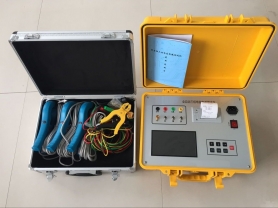
connection points, and grounding systems in electrical equipment. This testing is crucial for ensuring the safety and reliability of electrical systems, as excessive loop resistance can lead to local overheating, spark generation, and even fire hazards. The following will provide a detailed introduction to the knowledge related to loop resistance testers.
Importance of Loop Resistance Testing
Connection points or contact surfaces in electrical equipment may experience increased contact resistance due to oxidation, corrosion, wear, and other reasons, which can affect the normal operation of the equipment. Regular testing with a loop resistance tester can help detect these issues in a timely manner, allowing for measures to be taken for repair and avoiding potential safety hazards.
Working Principle
The working principle of a loop resistance tester is based on Ohm's law, which involves applying a constant current to the test object and then measuring the resulting voltage drop. Based on the measured voltage and the known current, the resistance value can be calculated. Common testing methods include:
Micro-ohmmeter method: Suitable for measuring small resistances, typically used for detecting internal contact points in electrical equipment.
Four-terminal method (Kelvin method): This method uses two pairs of terminals, one pair for applying current and the other for measuring voltage, to reduce the influence of lead resistance on the measurement results.
Main Functions and Features
High accuracy: Capable of measuring very small resistance values, typically with resolution down to the micro-ohm level.
Good stability: Maintains high measurement accuracy even during prolonged continuous operation.
Multiple measurement modes: Provides different measurement modes to suit various testing needs.
Data storage: Most modern instruments come with data storage capabilities for later analysis.
Application Scenarios
Loop resistance testers are widely used in various fields such as power systems, rail transit, and industrial automation. Specific application scenarios include:
Contact resistance testing of switchgear, circuit breakers, and other equipment in power substations.
Testing of electrical connection components in rail transit vehicles.
Maintenance of electrical equipment on factory production lines.
Testing of grounding systems to ensure grounding resistance meets safety standards.
Usage Precautions
Safety first: Before testing, ensure that the circuit under test is completely de-energized and appropriate protective measures are taken.
Correct selection of test points: Choose appropriate test points to avoid the influence of the measurement leads' own resistance on the results.
Reasonable setting of test parameters: Adjust the test current according to the specific conditions of the object under test to obtain the most accurate results.
Regular calibration: To ensure the accuracy of measurement results, the tester needs to be calibrated regularly.
Conclusion
The loop resistance tester is an important tool in the maintenance and testing of electrical equipment. Its use helps engineers detect and resolve hidden dangers in electrical systems in a timely manner, ensuring the safe operation of equipment. With the development of technology, the functions of such instruments will become more comprehensive, and their use will become more convenient and efficient.