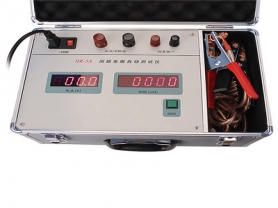
The safe and stable operation of the power system is crucial for modern society. Partial Discharge (PD) is an important indicator of insulation aging and damage in power equipment, which may lead to serious power failures. As an advanced detection tool, the ultrasonic partial discharge inspection and locating instrument can inspect and locate power equipment without power outage, promptly detecting potential partial discharge issues, thereby effectively preventing failures.
Product Overview
The ultrasonic partial discharge inspection and locating instrument is a portable device that uses ultrasonic signals to detect partial discharge phenomena inside power equipment. It can be used for partial discharge detection and location in high-voltage cable terminations, insulators, substation open equipment, dry-type transformers, main transformer bushings, and other power equipment.
Working Principle
Ultrasonic Signals: Ultrasound refers to sound waves with frequencies higher than 20kHz, which cannot be heard by the human ear. Partial discharge generates high-frequency sound waves, including ultrasonic components.
Signal Capture: The ultrasonic partial discharge inspection and locating instrument captures these ultrasonic signals through high-sensitivity sensors.
Signal Processing: The internal signal processor analyzes and processes the captured ultrasonic signals to determine whether partial discharge phenomena exist.
Location Function: By moving the device and listening to changes in signal strength, the approximate location of partial discharge can be determined.
Main Features
Non-invasive Detection: No need for power outage or equipment disassembly; detection can be performed while the equipment is in normal operation.
High Sensitivity: Capable of capturing weak ultrasonic signals, improving detection accuracy.
Intuitive Display: The device is typically equipped with an LCD display and headphone output, allowing direct display of waveforms or playback of ultrasonic signal sounds.
Accurate Location: The source of partial discharge is located through changes in signal strength, assisting maintenance personnel in quickly finding the problem.
Easy Operation: The handheld inspection and locating instrument is easy to carry and operate, suitable for on-site inspections.
Usage Method
Wear Headphones: Wear headphones to better listen to ultrasonic signals.
Turn on Power: Turn on the device power, hold the trigger with your finger, and aim the laser at the detection target.
Listen and Identify: Listen for beeping sounds or observe waveform changes on the display to determine if there is partial discharge.
Develop Scanning Cycle: Develop an appropriate monitoring cycle based on the equipment condition. Generally, a comprehensive scan is performed once a month, and the scanning frequency is increased for equipment with abnormal signs.
Application Cases
High-voltage Cable Termination Detection: Scan high-voltage cable terminations to check for discharge phenomena.
Insulator Detection: Scan insulators to confirm whether there is partial discharge.
Substation Open Equipment Detection: Scan substation open equipment to detect corona discharge.
Dry-type Transformer Detection: Scan dry-type transformers to detect discharge in coils.
Main Transformer Bushing Detection: Scan main transformer bushings to detect corona discharge in the main transformer.
Main Transformer Overall Detection: Scan the entire main transformer to detect abnormal vibrations.
Technology Development Trends
Intelligence: Integrate artificial intelligence technology to improve analysis accuracy and efficiency.
Multi-function Integration: In addition to basic partial discharge detection, other detection functions may be integrated.
Remote Monitoring: Support wireless transmission for remote monitoring and data analysis.
Conclusion
The ultrasonic partial discharge inspection and locating instrument, as an effective detection tool, plays an important role in the maintenance and failure prevention of power systems. With continuous technological development, future ultrasonic partial discharge inspection and locating instruments will be more intelligent and efficient, providing stronger support for the safe operation of power systems.
I hope this overview of the ultrasonic partial discharge inspection and locating instrument provides you with valuable reference. If you need more detailed information or have specific technical questions, please feel free to let us know.