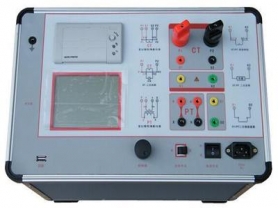
Transformers are indispensable components in power systems, used for voltage conversion to meet different electricity demands. The transformer capacity characteristic tester is a specialized device designed for measuring and evaluating transformer performance. This tester provides precise measurement data, helping power engineers and maintenance personnel better understand the working status of transformers, ensuring the stable operation of the power system.
Working Principle
The working principle of the transformer capacity characteristic tester mainly involves measuring various losses of the transformer, including hysteresis loss and eddy current loss. These losses are closely related to the efficiency of the transformer. Generally, the larger the power, the smaller the ratio of loss to output power, and the higher the efficiency. By measuring these losses and other characteristic parameters, the tester can evaluate the actual capacity and performance of the transformer.
Main Functions
The functions of the transformer capacity characteristic tester include but are not limited to:
Capacity Measurement: Determines the actual capacity of the transformer through some necessary data.
No-load Current Measurement: Measures the current of the transformer under no-load conditions.
No-load Loss Measurement: Measures the power loss of the transformer under no-load conditions.
Short-circuit Voltage Measurement: Measures the voltage of the transformer under short-circuit conditions.
Short-circuit Loss Measurement: Measures the power loss of the transformer under short-circuit conditions.
Zero-sequence Impedance Measurement: Measures the zero-sequence impedance of the transformer.
Waveform Distortion Correction: Automatically performs waveform distortion correction.
Temperature Correction: Automatically corrects measurement results based on ambient temperature.
Voltage Correction: Performs voltage correction during no-load tests under non-rated voltage.
Current Correction: Performs current correction.
Features
Precise Measurement: Capable of accurately measuring the capacity and other characteristic parameters of various distribution transformers.
Passive Measurement: No external power supply required for measurement.
High Automation: Automatically performs multiple corrections, simplifying the operation process.
Portable Design: Small size, light weight, easy to carry and use on-site.
Easy Operation: User-friendly interface, simple operation.
Usage Method
Connect Equipment: Correctly connect the various terminals of the transformer according to the tester's instruction manual.
Set Parameters: Set the corresponding parameters according to the characteristics to be measured.
Start Test: Start the tester and follow the prompts to operate.
Read Data: Read the test results from the tester's display screen.
Data Analysis: Analyze the performance of the transformer based on the test results.
Application Scenarios
Power System Maintenance: Regularly evaluate the performance of transformers in the power system to ensure their normal operation.
Fault Diagnosis: When a transformer is abnormal, quickly locate the problem using the tester.
Quality Inspection: Used for quality control and performance verification during transformer production.
Scientific Research: Used to evaluate the effectiveness of new materials or designs during transformer development.
Conclusion
The transformer capacity characteristic tester, as an efficient and precise testing tool, plays an important role in the field of power engineering. It not only helps maintenance personnel discover and solve problems in a timely manner but also improves the overall reliability and safety of the power system. With continuous technological advancement, future transformer capacity characteristic testers will become more intelligent and portable, bringing more convenience to the operation and maintenance of the power industry.