Railway transportation, communication base stations, and other fields requiring highly reliable electrical connections. The following is a detailed introduction to the loop resistance tester:
Purpose and Importance
Ensuring Safety and Reliability: By accurately measuring loop resistance, potential poor connections or corrosion issues can be detected, thereby avoiding failures caused by overheating or arcing.
Preventive Maintenance: Regular loop resistance testing helps identify potential problems and take action before small issues become major faults.
Quality Control: Using a loop resistance tester during manufacturing ensures that products meet specified electrical performance standards.
II. Working Principle
The loop resistance tester typically uses the four-wire method (Kelvin bridge) for measurement, which eliminates the influence of lead resistance on measurement results, providing more accurate readings. The specific steps are as follows:
Applying Current: The tester applies a known high current (e.g., 100A or higher) to the circuit under test to ensure a stable measurement signal even at low resistance values.
Measuring Voltage Drop: Simultaneously measure the tiny voltage drop generated when this current flows through the tested path.
Calculating Resistance: According to Ohm's law R = V/I, where R is resistance, V is voltage drop, and I is the applied current, calculate the loop resistance value.
III. Types and Features
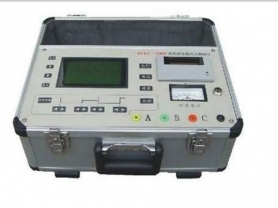
Handheld Loop Resistance Tester: Portable and lightweight, suitable for field use; built-in battery power supply, convenient to carry to different locations for testing.
Benchtop Loop Resistance Tester: Suitable for detailed analysis at fixed positions in laboratories or workshops, usually with higher accuracy and more functional options.
Automatic Loop Resistance Tester: Equipped with an automated control system, capable of automatically completing the entire testing process and recording data, ideal for large-scale production and continuous monitoring scenarios.
IV. Selection Guide
Measurement Range: Choose an appropriate measurement range based on the actual application to cover all expected measurement needs.
Accuracy Requirements: For measurements of critical parts, such as high-voltage circuit breaker contacts, a tester with higher accuracy may be required.
Output Current Capability: Ensure the tester provides sufficient current to obtain accurate results even at low resistance values.
User-Friendliness: Consider whether the operation interface is intuitive and easy to use, and whether there is sufficient help documentation and technical support services.
V. Usage Precautions
Safety: Before conducting any test, ensure the equipment is powered off and properly discharged to prevent electric shock accidents.
Environmental Conditions: Humidity, temperature, and other factors can affect test results, so try to maintain a stable testing environment.
Cleanliness: Ensure the test points are clean and free of dust, as dirt or moisture may cause inaccurate readings.
Calibration: To ensure the accuracy of measurement results, the loop resistance tester should be calibrated regularly.
VI. Technology Development Trends
With the advancement of technology, modern loop resistance testers are not limited to basic resistance measurement functions but also integrate more advanced features such as wireless transmission, remote monitoring, intelligent diagnostics, etc., greatly improving work efficiency and user experience.
Conclusion
Loop resistance testing is one of the important links to ensure the safe and reliable operation of electrical systems. Choosing a suitable and high-quality loop resistance tester and strictly following operating procedures plays an irreplaceable role in improving the quality of electrical connections. If you have further questions or need information on specific models, please feel free to ask.
I hope the above information helps you understand the loop resistance tester and its applications more comprehensively. If you have any questions or need more information, please feel free to ask.