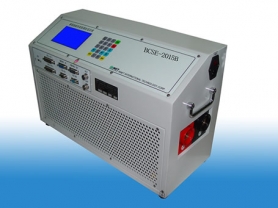
In power systems, the resistance value at electrical connection points directly affects the operational safety and efficiency of power equipment. As a professional tool, the loop resistance tester can accurately measure the resistance at connection points, helping technicians promptly identify potential issues and take measures to resolve them, thereby ensuring the normal operation of the power system.
II. Working Principle and Technical Features
The loop resistance tester mainly uses the four-terminal method (Kelvin method) for measurement, which effectively eliminates the influence of lead resistance on measurement results. During testing, the instrument applies a known current and measures the resulting voltage drop to calculate the resistance value.
Main technical features include:
High precision: Provides very high measurement accuracy, suitable for detecting small resistance values.
Wide measurement range: Typically covers resistance measurement from milliohms to thousands of ohms.
Fast response: Can complete tests in a short time, suitable for online detection.
Automatic range switching: Automatically adjusts the measurement range based on the size of the measured resistance.
Data storage and transmission: Supports storage of large amounts of data and can connect to computers via USB, Bluetooth, or wireless networks for data sharing.
III. Main Functions
Resistance measurement: Used to measure the resistance value at electrical connection points to ensure reliable connections.
Continuity testing: Checks whether the connections between conductors are intact and whether there are any breaks.
Fault location: Helps locate the position of fault points by analyzing changes in resistance values.
Temperature compensation: Considering that resistance values change with temperature, the instrument typically has a temperature compensation function.
IV. Application Scenarios
Loop resistance testers are widely used in the following fields:
Power systems: Used to detect connection resistance in cable joints, busbar connections, switchgear, etc.
Industrial manufacturing: Used on production lines to check the quality of solder joints and ensure reliable electrical connections.
Building electrical installation: Tests the quality of connections in building electrical systems, such as wiring in distribution boxes.
Transportation: Used in railway, subway, and other transportation systems to detect the connection status of track circuits.
V. Usage Case
For example, in a substation of a power company, technicians used a loop resistance tester to inspect cable joints. By comparing with standard resistance values, they found an abnormally high resistance at one joint, which was immediately repaired, avoiding a potential accident.
VI. Development Trends
With technological advancements, loop resistance testers are developing in the following directions:
Intelligence: Integrating more intelligent analysis functions, such as automatic fault diagnosis, to improve testing efficiency.
Portability: More compact and lightweight designs for easy field use.
Multi-parameter measurement: In addition to resistance, they can simultaneously measure other electrical parameters such as temperature and humidity.
Remote monitoring: Using internet technology for remote data collection and analysis, facilitating centralized management and decision support.
VII. Conclusion
Loop resistance testers play an important role in electrical testing in power systems and other fields due to their high precision, high reliability, and wide application range. With continuous technological progress, these testers will become more intelligent, portable, and possess stronger data processing and remote monitoring capabilities, providing better guarantees for the safety and efficiency of power systems.
This article provides an overview of the basic concepts, functional features, application scenarios, and future development trends of loop resistance testers. The specific content can be further expanded or adjusted according to actual needs. If there are any specific requirements or topics that need further discussion, please feel free to let us know.